
How Bengali Sentences Work: Word Order, Verb Endings and Pronouns
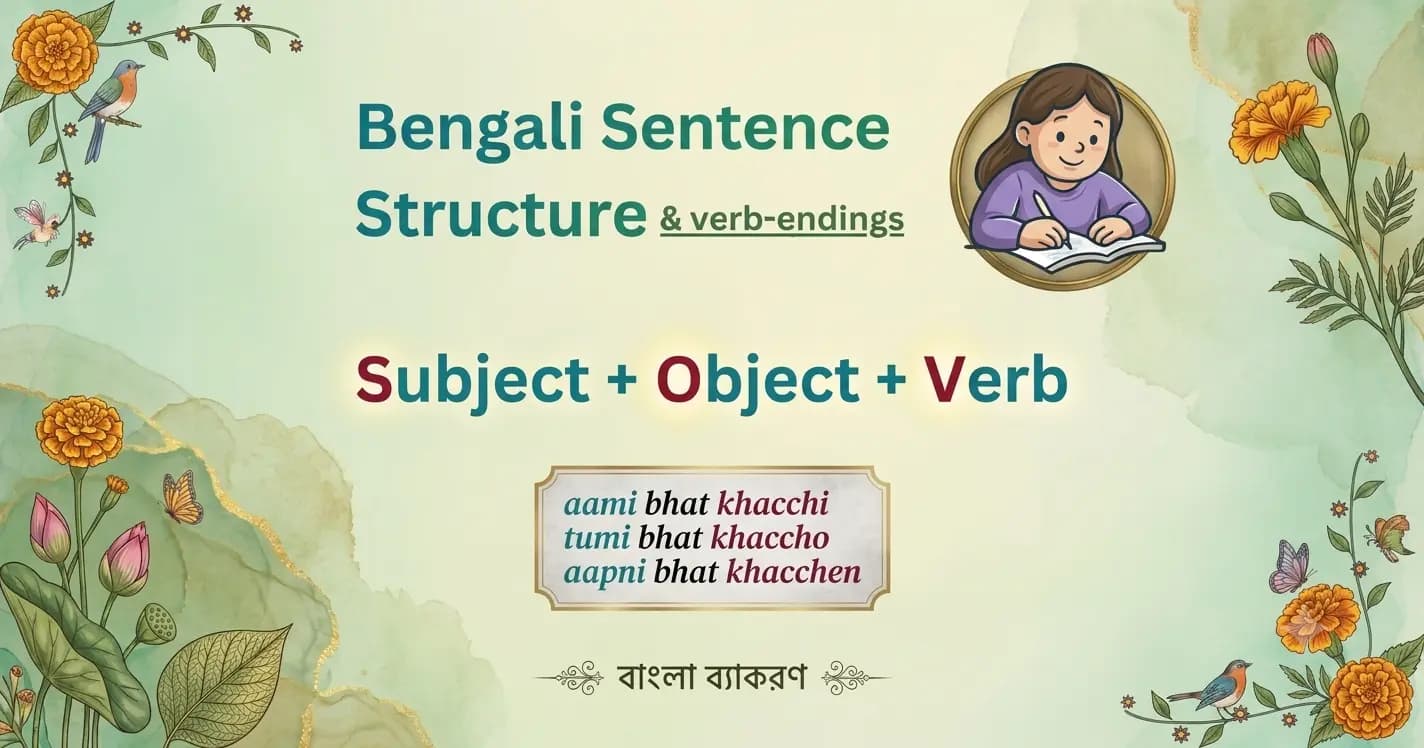
Bengali puts the verb last and changes verb endings to match who is speaking. Learn how sentences are built, with clear present, past and future examples.
Learn how Bengali builds a sentence, why the verb always waits until the end, and how a single pronoun quietly decides how your verb should sound.
Introduction: Same Ideas, Different Order
If you speak English and you are starting Bengali, the good news is that the basic ideas are the same. Someone does something. Sometimes they do it to something else. The difference is in how the pieces are arranged, and in how the verb changes shape.
There are two big ideas in this article:
- Bengali puts the verb at the end of the sentence.
- Bengali does not use helper words like am, is, are to build tenses. It changes the ending of the verb instead, and that ending depends on which pronoun you use.
Each example below is written as Romanized Bengali first, with the Bengali script in brackets and the English meaning alongside it.
Word Order: English is S + V + O, Bengali is S + O + V
Every simple sentence has three main parts:
- S (Subject): who does the action
- V (Verb): the action
- O (Object): what receives the action
English puts the verb in the middle: Subject + Verb + Object.
Bengali puts the verb last: Subject + Object + Verb.
Here is the same idea in both languages, all in the simple present tense.
English: I eat rice. (S + V + O) Bengali: Ami bhat khai. (আমি ভাত খাই।) (S + O + V)
Read the Bengali word by word: "I rice eat." That is the whole trick. Once you get used to saving the verb for last, Bengali sentences begin to feel natural.
More examples:
English: She reads a book. Bengali: Se boi pore. (সে বই পড়ে।) — "She book reads."
English: He drinks water. Bengali: Se jol khay. (সে জল খায়।) — "He water drinks."
English: Mother cooks food. Bengali: Ma ranna kore. (মা রান্না করে।) — "Mother cooking does."
English: We watch a movie. Bengali: Amra cinema dekhi. (আমরা সিনেমা দেখি।) — "We movie watch."
English: I love you. Bengali: Ami tomake bhalobashi. (আমি তোমাকে ভালোবাসি।) — "I you love."
Everything Else Sits Before the Verb Too
The verb is the anchor at the end, and the other details gather in front of it. Places, times and objects all come before the verb.
Ami skule jai. (আমি স্কুলে যাই।) — "I to-school go." (I go to school.)
Ram bajare aam kine. (রাম বাজারে আম কেনে।) — "Ram at-the-market mango buys." (Ram buys a mango at the market.)
Notice the small -e on skule and bajare. Bengali often adds a little ending to the noun to show "to," "in" or "at," where English uses a separate word in front of it.
Quick Comparison
| English | Bengali | |
|---|---|---|
| Pattern | Subject + Verb + Object | Subject + Object + Verb |
| Example | I eat rice. | Ami bhat khai. (আমি ভাত খাই।) |
| Place of the verb | Middle | End |
| Small helper words (to, in, at) | Come before the noun | Attach to the end of the noun |
No "Am, Is, Are": Bengali Changes the Verb Ending
English needs a team of helper words to show time. I am eating. I was eating. I will eat. I have eaten. The verb eat stays nearly the same, and the little words around it do the work.
Bengali does it differently. There are no am / is / are helpers stacked in front of the verb. Instead, the verb itself changes at the end to tell you the time of the action and who is doing it.
| English (helper words) | Bengali (verb endings) |
|---|---|
| I eat | Ami khai. (আমি খাই।) |
| I am eating | Ami khachchhi. (আমি খাচ্ছি।) |
| I ate | Ami khelam. (আমি খেলাম।) |
| I have eaten | Ami kheyechhi. (আমি খেয়েছি।) |
| I was eating | Ami khachchhilam. (আমি খাচ্ছিলাম।) |
| I will eat | Ami khabo. (আমি খাবো।) |
Look at the English column: five different helper patterns. Look at the Bengali column: one verb, kha-, wearing different endings. That is how Bengali expresses tense.
What About "To Be" in Simple Sentences?
In the present tense, Bengali simply leaves out "am / is / are" when you describe what someone is.
Ami shikkhok. (আমি শিক্ষক।) — "I teacher." (I am a teacher.)
Se daktar. (সে ডাক্তার।) — "He/She doctor." (He/She is a doctor.)
For past and future, there is a small verb that takes endings just like any other verb:
| Present | Past | Future | |
|---|---|---|---|
| I am / was / will be a teacher | Ami shikkhok. (আমি শিক্ষক।) | Ami shikkhok chhilam. (আমি শিক্ষক ছিলাম।) | Ami shikkhok hobo. (আমি শিক্ষক হবো।) |
To say that something exists or is located somewhere, Bengali uses the verb ach-: Ami bhalo achhi. (আমি ভালো আছি।) — "I am fine."
Pronouns Decide the Verb Ending
This is the part that surprises most learners. In English, the verb barely cares who the subject is. I eat, you eat, we eat, they eat. Only he/she eats changes.
In Bengali, every pronoun has its own verb ending. Switch the pronoun and the verb must switch with it.
Two things drive the change:
- Who is acting: I, you, or someone else.
- How respectful you are being. If you read our Introduction to Bengali Pronouns, you know Bengali has three levels of "you": apni (formal), tumi (friendly) and tui (very informal). Each one has its own ending.
Two nice bits of news: Bengali verbs do not change for gender (se means both "he" and "she," and the verb is identical), and they do not change for number (ami and amra share an ending).
Simple Present: One Verb, Five Endings
Take the verb kora (করা) — "to do." The stem is kor-, and the ending changes with the pronoun.
| Pronoun | Ending | Verb | Example |
|---|---|---|---|
| Ami (আমি) I, Amra (আমরা) We | -i | kori (করি) | Ami kaj kori. (আমি কাজ করি।) — I do work. |
| Tumi (তুমি) You, friendly, Tomra (তোমরা) | -o | koro (করো) | Tumi kaj koro. (তুমি কাজ করো।) — You do work. |
| Tui (তুই) You, very informal, Tora (তোরা) | -is | koris (করিস) | Tui kaj koris. (তুই কাজ করিস।) — You do work. |
| Se (সে) He/She, Ora (ওরা) They | -e | kore (করে) | Se kaj kore. (সে কাজ করে।) — He/She does work. |
| Apni (আপনি) You, formal, Tini (তিনি) He/She, formal, Apnara (আপনারা), Tara (তাঁরা) | -en | koren (করেন) | Apni kaj koren. (আপনি কাজ করেন।) — You do work. |
Notice that the formal pronouns apni and tini share the same ending, -en. The ending of the verb tells the listener how respectfully you are speaking, even before they think about the pronoun.
Same Pattern, Different Verbs
The endings stay the same across verbs. Here is khawa (খাওয়া) — "to eat," pora (পড়া) — "to read," and jawa (যাওয়া) — "to go."
| Pronoun | Eat | Read | Go |
|---|---|---|---|
| Ami (আমি) | khai (খাই) | pori (পড়ি) | jai (যাই) |
| Tumi (তুমি) | khao (খাও) | poro (পড়ো) | jao (যাও) |
| Tui (তুই) | khas (খাস) | poris (পড়িস) | jas (যাস) |
| Se (সে) | khay (খায়) | pore (পড়ে) | jay (যায়) |
| Apni / Tini (আপনি / তিনি) | khan (খান) | poren (পড়েন) | jan (যান) |
Verbs like kha- and ja- already end in a vowel, so they blend with the endings and sound slightly different (khay, jay). The pattern of -i, -o, -is, -e, -en is still there underneath.
Feel the Difference in Sentences
The same question, asked to three different people:
Apni ki khan? (আপনি কী খান?) — "What do you eat?" (to a teacher or an elder)
Tumi ki khao? (তুমি কী খাও?) — "What do you eat?" (to a friend)
Tui ki khas? (তুই কী খাস?) — "What do you eat?" (to a younger sibling or a very close friend)
Mixing them is where mistakes happen. Apni khas sounds odd and disrespectful, while tumi khan sounds oddly stiff. Keep the pronoun and the verb ending in the same family.
Putting It All Together: Pronoun + Tense = Verb Ending
Now we combine both ideas. To build a Bengali sentence, follow this recipe:
Subject + Object or Place + Verb stem + Tense marker + Person ending
The tense marker slots in between the stem and the ending:
- Present: stem + person ending (kor + i = kori)
- Past: stem + -l- + person ending (kor + l + am = korlam)
- Future: stem + -b- + person ending (kor + b + o = korbo)
Here is the verb jawa (যাওয়া) — "to go" in a full sentence, across all three tenses and every pronoun. The verb has a small change of stem in the past (ja- becomes ge-), which is worth memorizing as it is very common.
| Pronoun | Present | Past | Future |
|---|---|---|---|
| Ami (আমি) | Ami bajare jai. (আমি বাজারে যাই।) I go to the market. | Ami bajare gelam. (আমি বাজারে গেলাম।) I went to the market. | Ami bajare jabo. (আমি বাজারে যাবো।) I will go to the market. |
| Tumi (তুমি) | Tumi bajare jao. (তুমি বাজারে যাও।) | Tumi bajare gele. (তুমি বাজারে গেলে।) | Tumi bajare jabe. (তুমি বাজারে যাবে।) |
| Tui (তুই) | Tui bajare jas. (তুই বাজারে যাস।) | Tui bajare geli. (তুই বাজারে গেলি।) | Tui bajare jabi. (তুই বাজারে যাবি।) |
| Se (সে) | Se bajare jay. (সে বাজারে যায়।) | Se bajare gelo. (সে বাজারে গেলো।) | Se bajare jabe. (সে বাজারে যাবে।) |
| Apni (আপনি) | Apni bajare jan. (আপনি বাজারে যান।) | Apni bajare gelen. (আপনি বাজারে গেলেন।) | Apni bajare jaben. (আপনি বাজারে যাবেন।) |
Read down any column and you will see the endings you learned in the present tense keep returning: -i / -o / -is / -e / -en in the present, then -am / -e / -i / -o / -en in the past, and -o / -e / -i / -e / -en in the future.
One More Example, With an Object
Here is khawa (to eat) with an object, so you can see the S + O + V order and the tense endings working together.
Present: Ami bhat khai. (আমি ভাত খাই।) — I eat rice. Past: Ami bhat khelam. (আমি ভাত খেলাম।) — I ate rice. Future: Ami bhat khabo. (আমি ভাত খাবো।) — I will eat rice.
Present: Tumi bhat khao. (তুমি ভাত খাও।) — You eat rice. Past: Tumi bhat khele. (তুমি ভাত খেলে।) — You ate rice. Future: Tumi bhat khabe. (তুমি ভাত খাবে।) — You will eat rice.
Present: Apni bhat khan. (আপনি ভাত খান।) — You eat rice. (formal) Past: Apni bhat khelen. (আপনি ভাত খেলেন।) — You ate rice. (formal) Future: Apni bhat khaben. (আপনি ভাত খাবেন।) — You will eat rice. (formal)
Notice what stays the same in all nine sentences: the object bhat sits before the verb, and the verb is always the last word.
Quick Recap
| Idea | What to remember |
|---|---|
| Word order | Bengali is Subject + Object + Verb. The verb comes last. |
| No helper verbs | Tense is shown by the verb ending, not by am / is / are. |
| Pronouns matter | Each pronoun (ami, tumi, tui, se, apni) has its own verb ending. |
| Respect is built in | Apni and tini take -en. Tui takes -is. |
| No gender or number | Se is he and she. Ami and amra use the same ending. |
| Tense markers | Past adds -l-, future adds -b-, between the stem and the ending. |
Practice Makes Perfect
The fastest way to make this stick is to pick one verb and run it through every pronoun, out loud. Try jai, jao, jas, jay, jan until it flows, then say each one in a full sentence, ending with the verb every time.
Ready to put this into practice? Head over to your BongGo lessons and try the pronouns exercises to test what you have learned.
Comments
No comments yet. Start the conversation.