
Ishwar Chandra Vidyasagar: The Ocean of Knowledge Who Reshaped Bengal
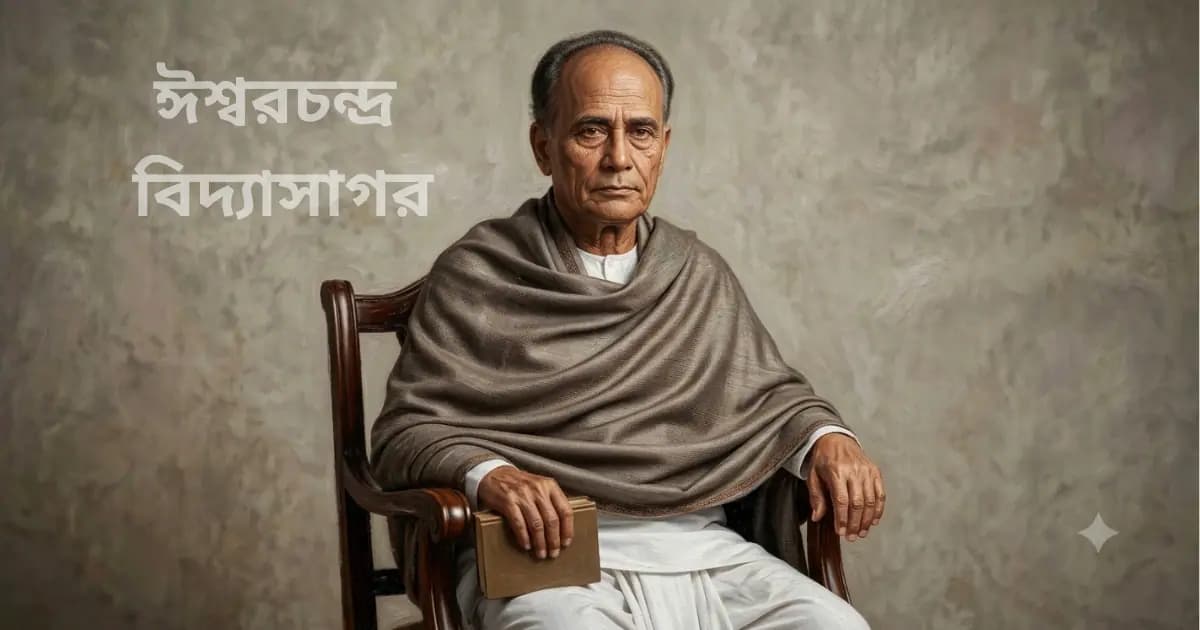
From studying under streetlamps to simplifying the Bengali script and winning the right of widows to remarry, discover the life and legacy of Ishwar Chandra Vidyasagar.
Few figures in nineteenth-century India left as deep a mark on both language and social conscience as Ishwar Chandra Vidyasagar. Born on September 26, 1820, in the small village of Birsingha in the Midnapore district of Bengal, he rose from grinding poverty to become one of the most celebrated scholars, educators, and reformers of his time — a man whose name is still invoked whenever Bengalis speak of courage paired with compassion.
A Childhood Shaped by Hardship
Vidyasagar's early life was marked by scarcity. His family could not always afford the basic comforts of a household, and there are enduring accounts of the young boy studying under streetlamps because there was no lamp or oil to spare at home. At the age of nine, he was sent to Calcutta to continue his education, where he supported himself through part-time tutoring while attending Sanskrit College. It was here, over twelve rigorous years of study — covering grammar, literature, dialectics, Vedanta, smriti, and astronomy — that he earned the honorific "Vidyasagar," meaning "Ocean of Knowledge," a title the institution itself conferred upon him in recognition of his extraordinary command of Sanskrit learning. He was born Ishwar Chandra Bandyopadhyay; the title he earned became the name by which history remembers him.
This hunger for learning was not incidental. It shaped his lifelong conviction that education was the single most powerful tool for social transformation — a belief he would spend the rest of his life acting upon.
Career and Educational Reform
After graduating in 1841, Vidyasagar joined Fort William College as head of its Sanskrit department. In 1846, he moved to Sanskrit College as Assistant Secretary, where he began pushing for structural reforms in how the institution taught and admitted students. He briefly stepped away in 1849 before returning in 1851 as its principal — a position from which he introduced English-language instruction alongside Sanskrit studies and, notably, opened admission to students from lower castes at a time when such access was almost unthinkable in traditional Sanskritic education.
Vidyasagar also reshaped the very shape of the Bengali alphabet and its teaching. He restructured and simplified the Bengali script into the more legible, systematic form still recognizable today, doing away with redundant characters and standardizing how children were taught to read. His primer Barnaparichay (1855) embodied this reform, replacing rote memorization of meaningless syllables with simple, comprehensible words and sentences — an innovation that made literacy dramatically more accessible to ordinary Bengali children.
The Fight for Widows: Beyond Sati, Toward Remarriage
By the time Vidyasagar began his public life, the practice of sati — the immolation of widows on their husbands' funeral pyres — had already been outlawed in 1829, largely through the efforts of Raja Rammohan Roy a generation earlier. But the abolition of sati had not ended the suffering of Hindu widows. Countless women, some married as children and widowed before adulthood, were condemned to a lifetime of social exile, tonsured heads, austere diets, and enforced celibacy simply because remarriage was considered a violation of Hindu custom.
It was this unfinished struggle that Vidyasagar took up with extraordinary determination. Drawing on his deep knowledge of Hindu scriptures, he argued — using Sanskrit textual authority rather than Western argument alone — that widow remarriage was not, in fact, prohibited by the shastras, and that orthodox opposition to it rested on custom rather than scripture. He wrote extensively on the subject, most notably in his two-part treatise Bidhaba Bibaha (1855), and petitioned the Legislative Council directly despite fierce resistance from conservative sections of Hindu society, some of whom threatened him and ostracized his family. His campaign succeeded: the Hindu Widows' Remarriage Act was passed in 1856 under Lord Dalhousie's administration, legalizing what had long been forbidden.
Vidyasagar did not stop there. He went on to campaign against child marriage and polygamy — both practices he saw as intertwined causes of the suffering he had witnessed, writing Bahu-Bibaha on the evils of polygamy and further tracts on the dangers of marrying off girls before they came of age. His advocacy on age of consent laid groundwork that would culminate, years after his death, in the Age of Consent Act of 1891.
Champion of Women's Education
Reforming law was only one part of Vidyasagar's mission; he believed reform without education was incomplete. He served as secretary of the Hindu Female School, which was later renamed Bethune School, and worked tirelessly to expand schooling opportunities for girls at a time when female literacy was almost nonexistent in most of Bengal. He is credited with helping establish dozens of schools for girls across the region, personally funding many of them from his own modest income.
In his later years, spent largely among the Santhal tribal community in Karmatar (in present-day Jharkhand), he continued this work — founding a girls' school and a night school for adults, and even running a free clinic offering homoeopathic treatment to the impoverished tribal population around him. Despite his fame and his associations with the colonial administration, Vidyasagar's compassion was most visible in these quiet, unglamorous acts of service far from Calcutta's intellectual circles.
Achievements and Legacy
Vidyasagar's contributions were formally recognized in 1877, when he was made a Companion of the Order of the Indian Empire. But his truer legacy lies elsewhere: in the standardized Bengali script still used today, in generations of readers first taught with Barnaparichay, and in the enduring cultural memory of a man who used both scholarship and personal risk to challenge deeply entrenched injustice. Rabindranath Tagore, reflecting on Vidyasagar's singular character, is said to have marveled at how, "in the process of producing forty million Bengalis, God produced one true man." In 2004, a BBC poll ranked him among the greatest Bengalis of all time.
Vidyasagar died on July 29, 1891, in Calcutta, at the age of seventy — but institutions bearing his name, from Vidyasagar College to Vidyasagar University and the Vidyasagar Setu bridge over the Hooghly, continue to testify to how thoroughly he reshaped Bengali intellectual and social life.
Prominent Books Written by Ishwar Chandra Vidyasagar
- Barnaparichay (Parts I & II, 1855) — the foundational Bengali primer that reshaped how generations of children learned to read.
- Bodhoday (1851) — an early educational text introducing basic concepts to young students.
- Kathamala (1856) — a collection of moral stories for children, adapted from Aesop's fables.
- Charitabali (1856) — biographical sketches intended for moral and educational instruction.
- Byakaran Kaumudi (1853–1863) — a Bengali grammar composed for students.
- Bidhaba Bibaha (Parts I & II, 1855) — his landmark treatise arguing for the legality and necessity of Hindu widow remarriage.
- Bahu-Bibaha (Parts I & II, 1871–1873) — a critical examination of the practice of polygamy.
- Betaal Panchavinsati (1847) — a Bengali prose adaptation of classic Sanskrit folk tales.
- Shakuntala (1854) — a celebrated Bengali rendering of Kalidasa's Sanskrit drama.
- Sitar Banabas (1860) — a retelling of an episode from the Ramayana, admired for its prose style.
- Bhrantibilash (1886) — a Bengali adaptation of Shakespeare's The Comedy of Errors.
Comments
No comments yet. Start the conversation.